
Prosecutors Allege White-Collar Crime Scheme in Nadiem Makarim Case
Reporter
Antara
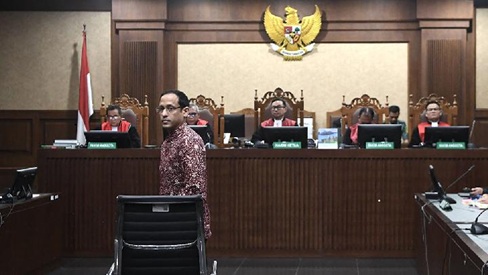
TEMPO.CO, Jakarta – Prosecutors from the Attorney General's Office alleged a white-collar crime scheme in the
In a written statement on Thursday, prosecutor Roy Riady said that the alleged scheme took advantage of bureaucratic loopholes and official authority for Nadiem's personal gain.
"The scheme took advantage of bureaucratic loopholes and positions of authority for Nadiem's personal gain," Roy said.
He added that the defendant used his authority to create a non-transparent decision-making system.
"Instead of strengthening the existing bureaucracy, he built a decision-making mechanism outside of formal channels, which ultimately resulted in commercial gain for certain parties," he said.
Alleged Shadow Organization
The prosecution also alleged a structured conflict of interest, claiming that Nadiem did not operate within a healthy bureaucratic system, but rather formed an unofficial "shadow" organization outside the ministry's official structure.
According to prosecutors, the entity was strongly suspected of steering policy decisions for personal business interests linked to a network of technology companies.
Questionable Finances and Investment Flows
The prosecution further pointed to what they called irregularities in Nadiem's wealth report, which they said were disproportionate to his income as a state official.
The court trial allegedly revealed a connection between the Chromebook procurement case and fraud in the management of PT Aplikasi Karya Anak Bangsa (AKAB), which involved massive external investment.
Prosecutors said that Google invested around US$786 million (around Rp11 trillion), but that figure was only recorded as Rp60 billion in administrative reports.
"We see a scheme to obscure the true value to avoid taxes and hide a conflict of interest," Roy said.
Allegations of Unexplained Wealth
The prosecution also criticized Nadiem for not utilizing the reverse burden of proof mechanism to thoroughly explain the origins of his assets.
They said that he often would not provide clear answers when asked about his salary and the sources of funding allegedly used to influence certain parties.
In addition to an 18-year prison sentence, prosecutors demanded a fine of Rp1 billion (subsidiary to 190 days in prison) and Rp5.67 trillion in restitution, covering state losses and unverified wealth.
Failure to pay the restitution will result in an additional nine-year prison sentence.
The prosecution also strongly opposed the testimonies delivered by three expert witnesses for the defense, arguing that their statements were neither independent nor objective.
The experts were identified as constitutional law expert I Gede Pantja Astawa, criminal law expert Romli Atmasasmita, and education
Questions over Expert Credibility
Prosecutors specifically questioned Romli's independence, citing family ties with a member of Nadiem's legal team at ADP Law Firm.
They also noted that testimony from I Gede Pantja Astawa had previously been disregarded by judges in another corruption case involving former health minister Siti Fadilah Supari.
Regarding Ina Liem, prosecutors said that she appeared more like a social media content creator defending Nadiem rather than an independent expert, arguing that her explanations lacked academic depth and familiarity with the case details.
Beyond personal ties, prosecutors also criticized the substance of the expert testimonies, which they said uniformly concluded that no wrongdoing was committed by Nadiem from an administrative, criminal, or policy perspective.
"The expert testimonies essentially tried to justify the defendant's actions without considering the factual evidence presented in court," Roy said.
Previously, prosecutors accused Nadiem of causing Rp2.18 trillion in state losses through the Ministry of Education's 2019–2022 digitalization program involving Chromebook laptops and Chrome Device Management (CDM).
They claimed that the procurement process violated planning procedures and procurement principles, while benefiting certain parties through a structured scheme.
Nadiem is accused of acting together with three other defendants in separate trials — Ibrahim Arief alias Ibam, Mulyatsyah, and Sri Wahyuningsih — as well as fugitive Jurist Tan.
According to prosecutors, the state losses included Rp1.56 trillion linked to the digitalization program and US$44.05 million (around Rp621.39 billion) from the allegedly unnecessary CDM procurement.
Prosecutors also claimed that Nadiem received Rp809.59 billion related to PT Aplikasi Karya Anak Bangsa (AKAB) through PT Gojek Indonesia, with the majority of funds coming from a US$786.99 million Google investment.
They further pointed to Nadiem's 2022 state wealth report (LHKPN), which recorded Rp5.59 trillion in the form of securities.
He is accused of violating Article 2(1) or Article 3 in conjunction with Article 18 of the Anti-Corruption Law (Law No. 31/1999 as amended by Law No. 20/2001), as well as Article 55(1) of the Criminal Code.
Related Articles

Viral Call for August Protests on Social Media, Metro Police Forms This Special Team
The Jakarta Metro Police has officially formed a Preventive Strike Team to conduct early mitigation, detection, and monitoring regarding demonstration calls on …
Read more
Lawyer Says Cash, 74 Kg of Gold Do Not Belong to Febrie Adriansyah
Former Deputy Attorney General Febrie Adriansyah, through his lawyer Hotman Paris, firmly denies ownership of the 74 kg of gold and millions …
Read more
Indonesia Bars Ex-Prosecutor Febrie Adriansyah From Leaving the Country
The Indonesian government has officially imposed a six-month travel ban on former prosecutor Febrie Adriansyah, preventing him from leaving the country. The …
Read more